
Details
Advanced Modular Operation Theatres
HomeAdvanced Modular Operation Theatres (OTs) & Medical Equipment Solutions
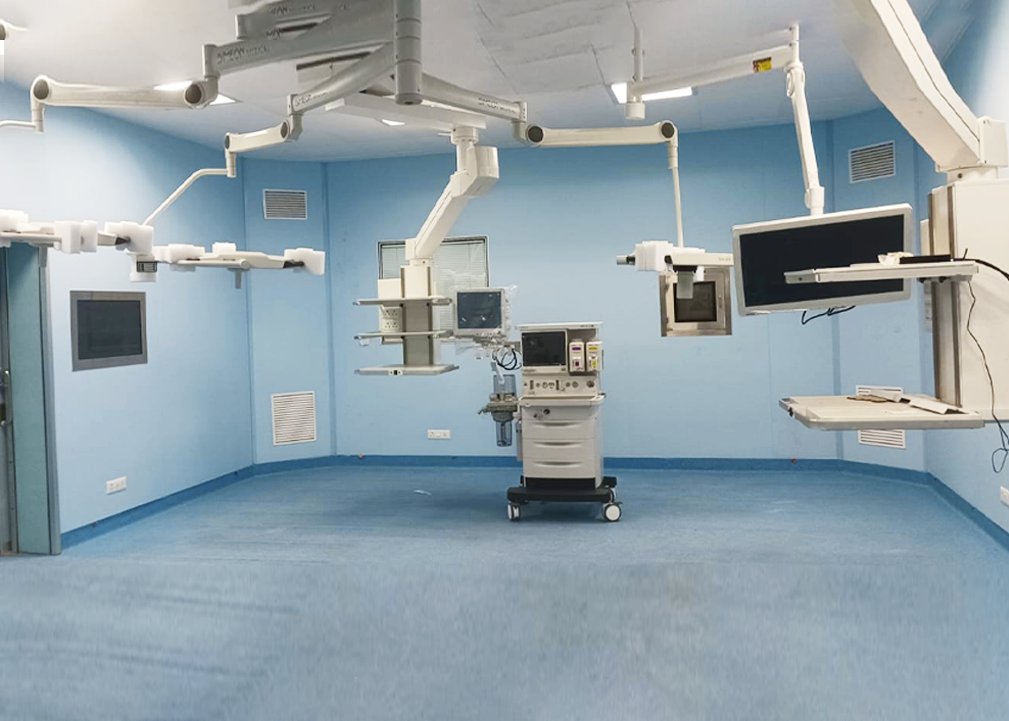
Advanced Modular Operation Theatres (OTs) & Medical Equipment Solutions
What needs to be in the system
- Modular wall/ceiling panels, sealed to the right ISO cleanroom class for OT use
- Laminar airflow ceiling plenum over the operating table, HEPA-filtered, validated air change rate
- Positive pressure relative to adjacent corridors, to keep outside air from flowing in
- Anaesthetic Gas Scavenging System (AGSS) — removes waste anaesthetic gas, not optional once inhalational anaesthesia is used
- Integrated pendants/boom for gas, power and equipment, keeping cabling out of the sterile field
- Control panel (pressure/humidity/temp), scrub station, and task-rated OT lighting
Standard it should comply with
- DIN 1946-4 — German standard, the most widely referenced spec for laminar airflow OT design
- ISO 14644-1 — cleanroom classification, sets the particle-count class an OT air system must hit
- HTM 03-01 — UK standard covering OT ventilation and AGSS design
- ISO 80601-2-13 — anaesthesia workstation standard, includes scavenging requirements
- NABH accreditation (India) — makes OT infrastructure a mandatory NABH accreditation item
How to assess your hospital’s needs
Laminar vs turbulent airflow:
| Laminar (unidirectional) | Turbulent (conventional) | |
|---|---|---|
| Air pattern | Directs filtered air straight down over the table | Mixes air across the room |
| Infection control | Lowest particle count at the surgical site | Adequate for lower-risk cases only |
| Best for | Implant, cardiac, transplant surgery | General surgery, lower-acuity OTs |
| Cost | Higher | Lower |
AGSS — powered vs passive extraction:
| Powered (active) | Passive | |
|---|---|---|
| How it works | A dedicated extractor pulls waste gas out continuously | Depends on the room’s own ventilation and pressure balance to carry gas away |
| Reliability | Works regardless of room conditions | Only as reliable as the room balance staying correct |
| Best for | Any OT running inhalational anaesthesia | Rarely enough on its own |
Bottom line: laminar flow for implant/cardiac/transplant OTs, turbulent is fine for general surgery. Powered AGSS wherever inhalational anaesthesia is used — don’t rely on passive extraction alone.
- Confirm case mix first (how many OTs actually need laminar vs turbulent) before costing the full suite — not every OT needs the top-spec setup
How to choose a vendor
- Ask for validated air change rate and particle-count test reports from a live OT, not just plenum spec sheets
- Check AGSS design experience specifically — not every OT contractor gets scavenging right
- Confirm they coordinate directly with your MEP/HVAC contractor — OT ventilation success depends on that interface
- Confirm post-handover requalification schedule — OT air systems need periodic reverification, not a one-time certificate
What not to do
- Don’t install turbulent flow for implant/cardiac/transplant OTs to save cost — that’s exactly the infection risk laminar flow exists to reduce
- Don’t treat AGSS as an HVAC afterthought — design it with the gas/vacuum system, not bolted on later
- Don’t skip commissioning particle-count and air change validation
- Don’t let OT shell, MEP, and gas/AGSS contractors design in isolation — that gap is the most common cause of OT commissioning delay